 Trainwreck
No BPMs.
No waveforms.
No sync.
Just your ears.
No one likes a trainwreck. Keep your trains on track with two decks in your pocket.
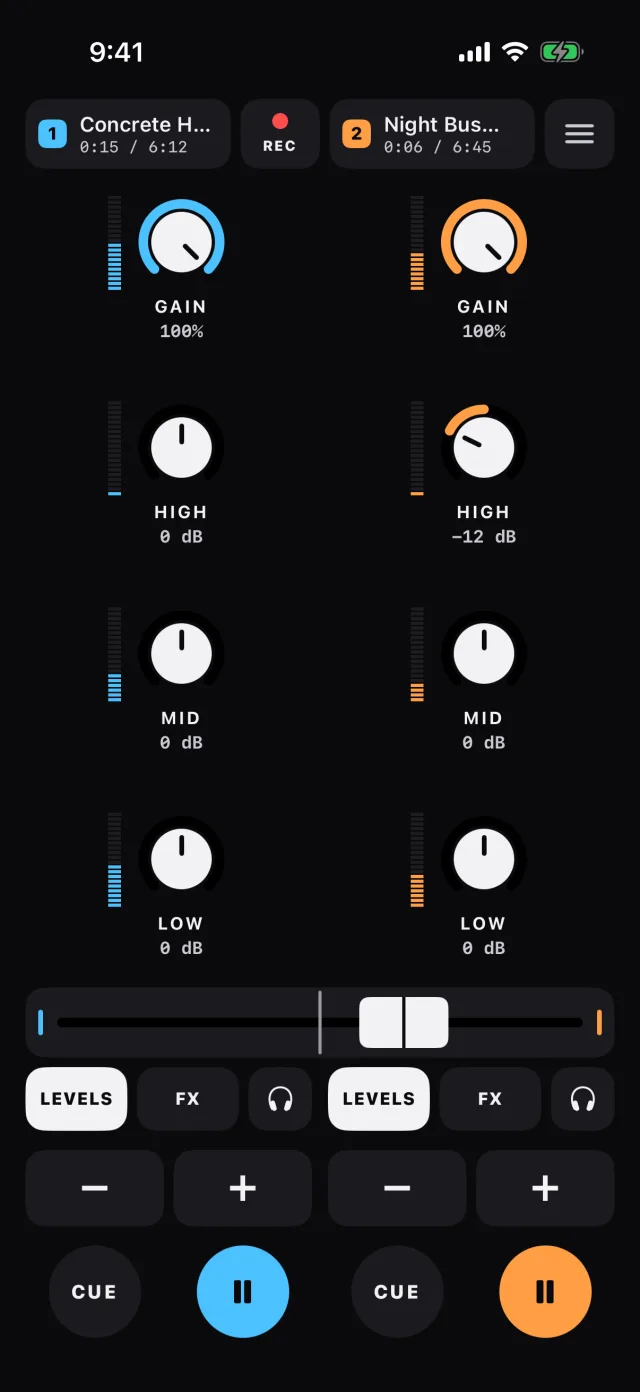
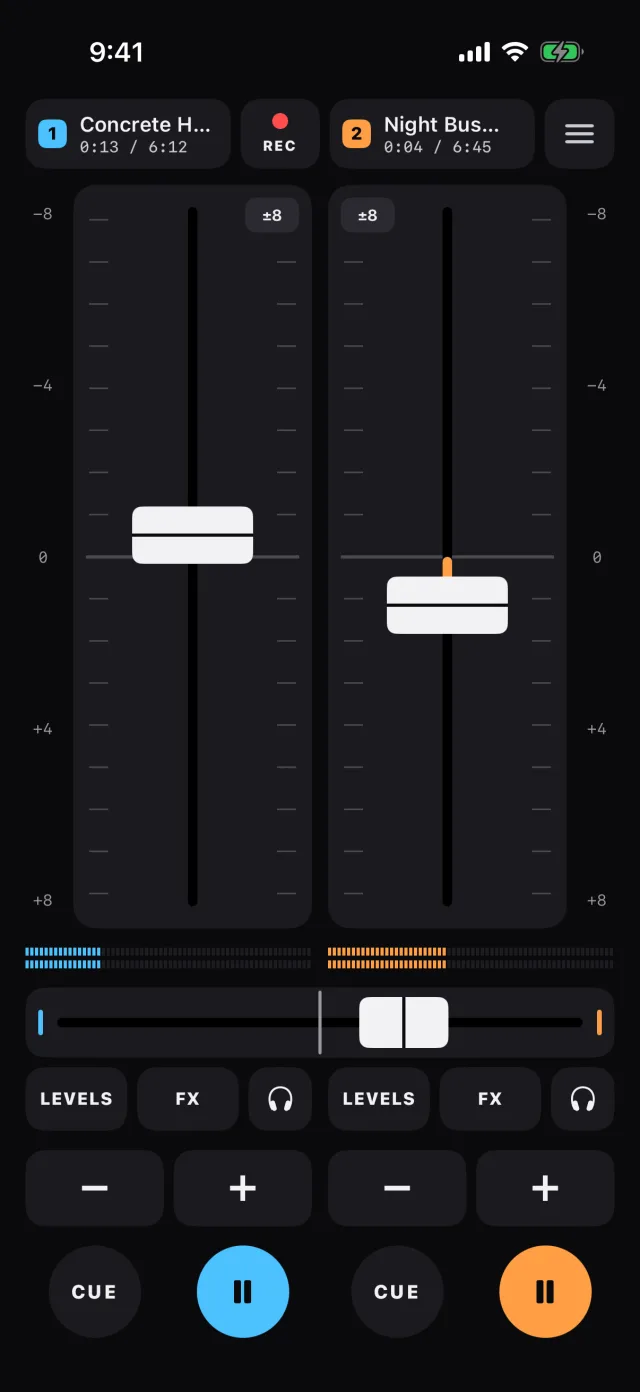
Two turntables and a mixer, in your pocket.
Pitch faders with ±4, ±8 or ±16% of shift. A crossfader between the decks. Gain and three-band EQ, laid out like the mixer in the booth. Filter, phaser, delay and low-cut echo.
Pitch
A long vertical fader per deck. Up is slower, down is faster, and speed and pitch move together like vinyl. The range chip switches between ±8, ±16 and ±4. When the kicks start to gallop, hold − or + to nudge them back.
- Range ±8 / ±16 / ±4
- Nudge ±1%
Levels
Gain, high, mid and low on a channel strip, each with its own meter. Gain sets each deck's level, and the crossfader blends between them.
- Gain
- High
- Mid
- Low
FX
Filter, phaser, delay and a low-cut echo that trims the lows from every repeat, so the tail never muddies the kick. Delay and echo time follow the track as you ride the pitch. ON blinks at a fixed 1 Hz so it never gives the tempo away.
- Filter
- Phaser
- Delay
- Low-cut echo
What's on the decks.
Cue on touch
The cue point sits at the first sound in the file. Hold CUE to preview from there.
Play on the downbeat
PLAY starts the moment your finger lands, not when you lift it, so you can drop the track right on the one. Tap again to pause.
Monitor off the record
Switch a deck to monitoring and it keeps playing, but stays out of the recording until you bring it in.
Record the mix
REC captures the master. When you stop, name and save the take, or delete it.
Crossfader
Runs the full width under the decks. Both play at full volume in the middle, and sliding toward one side fades the other out. Double-tap to snap back to centre.
Light and dark
Follows the system or stays where you set it. The light theme uses darker deck colours to keep the contrast up.
On its own, or plugged into the booth.
One deck
A single player for a spare mixer channel. Drop song ideas from your phone into a set on the main decks.
Two decks
The default. Both decks through the phone's output, with the app's own crossfader, EQ, effects, monitoring and recording.
Mixer out
Connect a USB mixer or interface with four or more outputs. Each deck goes to its own stereo pair, and the mixer handles levels, EQ, effects and cueing.
Deck 2 → out 3–4
Every DJ has had one. The whole room heard it.
A trainwreck is two records drifting apart. First the kicks flam, then they gallop, then they fight. It happens to everyone. You get out of it by catching it early, and only your ears can do that.
- 1
Hear it
The kicks start to flam. That's your cue, not a number on a screen.
- 2
Nudge it
Hold − or + to bend the tempo and pull the beats back on top of each other.
- 3
Ride it
Move the pitch slider a hair so they stay together. Then keep listening.